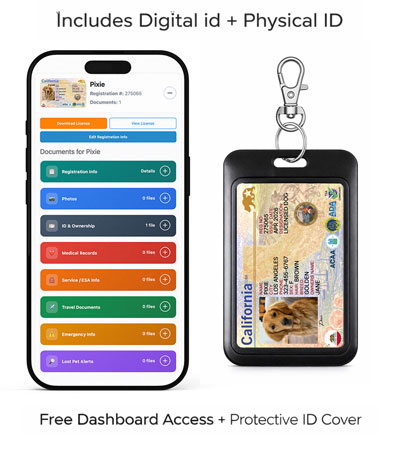
Lafayette County Dog Registration Information
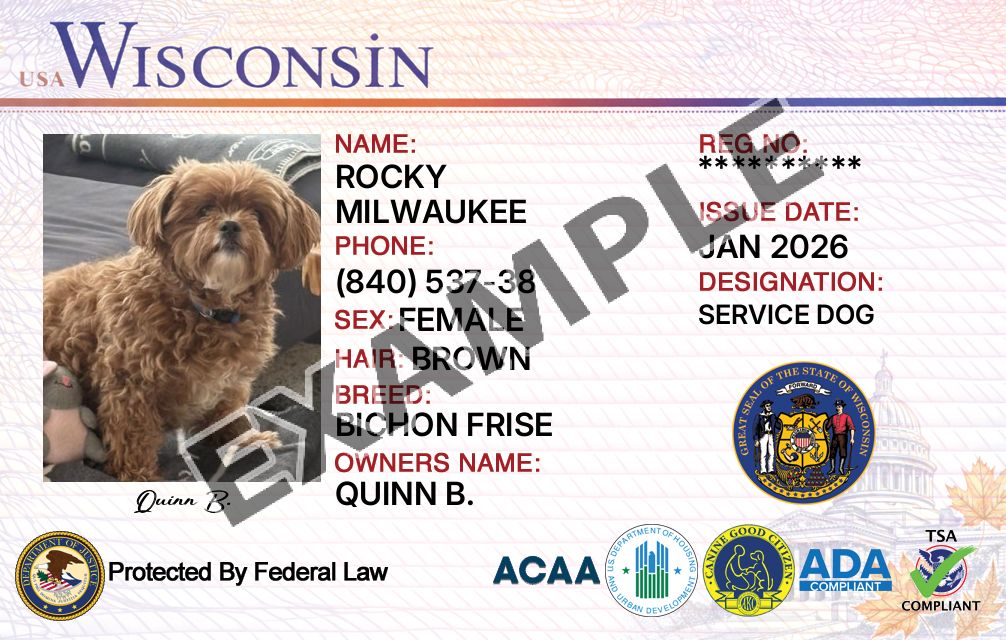
Service Dogs and Emotional Support Animals in Lafayette, Wisconsin
If you’re asking where do I register my dog in Lafayette County, Wisconsin for my service dog or emotional support dog, the key thing to know is this: a dog license in Lafayette County, Wisconsin is typically issued by your local municipality (city, village, or town), not by a private “registration” company.
This page explains where to register a dog in Lafayette County, Wisconsin (using official public offices), what you’ll need to license your dog, and how licensing differs from your dog’s status as a service dog or an emotional support animal (ESA).
Where to Register or License Your Dog in Lafayette County, Wisconsin
In Lafayette County, dog licenses are commonly obtained by contacting your local municipal treasurer. Below are several example official offices within Lafayette County, Wisconsin where residents often handle dog licensing, permits, and other local services. (If you live outside city/village limits, your town treasurer/clerk may be the right office.)
Official County Starting Point (Find Your Municipal Treasurer)
| Office | Lafayette County Clerk |
|---|---|
| Address | 626 Main Street, Room 204 |
| City/State/ZIP | Darlington, WI 53530 |
| Phone | (608) 776-4850 |
| carla.jacobson@lafayettecountywi.org | |
| Hours | Mon–Thu 7:30 a.m.–4:30 p.m.; Fri 7:30 a.m.–2:00 p.m. |
Use this office’s county guidance to identify the correct municipal treasurer for your exact address.
City of Darlington (City Office / Clerk-Treasurer)
- Address: 627 Main Street
- City/State/ZIP: Darlington, WI 53530
- Phone: (608) 776-4970
- Clerk-Treasurer Phone: (608) 776-4972
- Office hours: Not listed on the referenced contact page
City of Shullsburg (City Clerk/Treasurer)
- Physical address: 190 N. Judgement Street
- Mailing address: PO Box 580
- City/State/ZIP: Shullsburg, WI 53586
- Phone: (608) 965-4424
- Email: info@cityofshullsburg.org
- Office hours: Not listed on the referenced permits/licensing page
Village of Argyle (Village Clerk’s Office)
- Address: 401 E. Milwaukee St.
- City/State/ZIP: Argyle, WI 53504
- Phone: (608) 543-3113
- Email: clerk@argylewi.org
- Office hours: Mon–Fri 8:00 a.m.–4:00 p.m.
Village of Belmont (Clerk’s Office)
- Address: 222 S Mound Ave
- City/State/ZIP: Belmont, WI 53510
- Phone: (608) 733-6272
- Email: Not listed on the referenced clerk page
- Office hours: Mon–Fri 7:30 a.m.–11:30 a.m. and 12:00 p.m.–4:00 p.m.
Overview of Dog Licensing in Lafayette County, Wisconsin
What “registering” your dog usually means
When most people say “register my dog,” they’re usually talking about obtaining a local dog license and making sure their dog meets rabies vaccination rules. In Lafayette County, the County Clerk’s office provides guidance indicating that you should contact your local municipal treasurer to obtain a dog license. That’s why two neighbors in different parts of the county may use different offices—even though both are in Lafayette County.
Why dog licenses matter (even for service dogs and ESAs)
Dog licensing supports local administration and helps link a dog to an owner if the dog is found loose. It may also be used by local officials during rabies enforcement or bite investigations. Importantly, a local license is about public health and identification—not about “certifying” your dog as a service animal or emotional support animal.
Rabies vaccination is typically required to get a license
In Wisconsin municipalities, dog licensing commonly requires proof of a current rabies vaccination before the local clerk/treasurer can issue a license. For example, the City of Shullsburg’s licensing guidance states that proof of rabies vaccination is needed before a license can be issued, and notes a potential late fee if licensing is obtained after a stated date. Your municipality may also set its own schedule for renewals and late fees.
How Dog Licensing Works Locally in Lafayette County, Wisconsin
Step 1: Identify your municipality (city, village, or town)
The most reliable way to figure out where to register a dog in Lafayette County, Wisconsin is to start with your home address and determine whether you live in: a city (like Darlington or Shullsburg), a village (like Argyle or Belmont), or a town (unincorporated area). The office that issues your license is usually tied to where the dog is kept, not where the dog was purchased or where your veterinarian is located.
Step 2: Contact the clerk/treasurer (or municipal treasurer)
Many communities issue dog licenses through a Clerk/Treasurer or Municipal Treasurer office. This is where you’ll typically:
- Submit an application (online, by mail, or in person depending on the municipality)
- Provide rabies vaccination documentation
- Pay the local licensing fee
- Receive a license record and a tag for your dog’s collar
Step 3: Renew on the local schedule
Licensing is often annual and renewal dates can be set by local practice. For instance, Shullsburg notes its dog license expires December 31 regardless of when it’s issued and indicates late licensing after a specified date may trigger a late fee. Always confirm renewal timing and deadlines with your local office because policies can vary by municipality.
Animal control, rabies enforcement, and “who to call”
If your goal is specifically an animal control dog license Lafayette County, Wisconsin answer, your local clerk/treasurer is typically the licensing point of contact, while animal control or law enforcement may be involved in enforcing local ordinances (such as stray dog response or bite investigations). If you are unsure which office handles what, start with your municipality’s clerk/treasurer, or use the County Clerk’s office guidance to locate the correct municipal treasurer.
Service Dog Laws in Lafayette County, Wisconsin
A service dog’s legal status is not the same as a dog license
A dog license in Lafayette County, Wisconsin is a local licensing/tax and public health process. A service dog, by contrast, is defined under federal disability law as a dog individually trained to do work or perform tasks for a person with a disability. This means your dog becomes a service dog because of task training that mitigates a disability, not because of a county “registration.”
No official “service dog registration” is required for public access
Under federal guidance on service animals, businesses and public entities generally cannot require special ID cards, training documentation, or medical documentation as a condition of entry. In many situations, staff are limited to asking two questions: whether the dog is a service animal required because of a disability, and what work or task the dog has been trained to perform.
Service dogs still must follow local animal control and public health rules
Even with service dog protections, handlers are generally not exempt from local animal control or public health requirements. That means your service dog may still need to be vaccinated for rabies and licensed locally where required, just like any other dog.
What service dog owners should do in practice
If you have a service dog in Lafayette County, the practical path is: keep rabies vaccination current, obtain your local license through the correct municipal office, and focus on your dog’s training and behavior standards for safe public access. If someone tells you that you must “register” your service dog with a third-party service to make it legal, treat that claim with caution and verify with official sources.
Emotional Support Animal Rules in Lafayette County, Wisconsin
An ESA is not the same as a service dog
An emotional support animal (ESA) can be important for mental health, but it is generally different from a service animal under federal ADA rules. The key difference is that a service dog is trained to perform specific tasks related to a disability, while an ESA’s primary role is emotional support/comfort and does not require task training.
ESAs typically do not have the same public-access rights
ESAs are not generally treated as service animals for access to restaurants, stores, and many public places under the ADA service animal definition. That means an ESA usually cannot accompany you everywhere a service dog can, unless a specific facility or policy allows it.
Local licensing still applies to ESAs
Even if your dog is an ESA, your municipality may still require a local dog license and proof of rabies vaccination. So if you’re trying to figure out where to register a dog in Lafayette County, Wisconsin for an ESA, the answer is the same starting point: your local city/village/town licensing office (often the clerk/treasurer or municipal treasurer).
Frequently Asked Questions
Quick reminder
If your search is “where do i register my dog in Lafayette County, Wisconsin for my service dog or emotional support dog,” the practical answer is: (1) license the dog locally (municipal clerk/treasurer/treasurer), (2) keep rabies vaccination current, and (3) understand that service dog or ESA status is governed by different rules than licensing.
Register A Dog In Other Wisconsin Counties
Select your county below to get started with your dog’s ID card. Requirements and license designs may vary by county, so choose your location to see the correct options and complete your pup’s registration.
- Adams County Dog Registration
- Ashland County Dog Registration
- Barron County Dog Registration
- Bayfield County Dog Registration
- Brown County Dog Registration
- Buffalo County Dog Registration
- Burnett County Dog Registration
- Calumet County Dog Registration
- Chippewa County Dog Registration
- Clark County Dog Registration
- Columbia County Dog Registration
- Crawford County Dog Registration
- Dane County Dog Registration
- Dodge County Dog Registration
- Door County Dog Registration
- Douglas County Dog Registration
- Dunn County Dog Registration
- Eau Claire County Dog Registration
- Florence County Dog Registration
- Fond du Lac County Dog Registration
- Forest County Dog Registration
- Grant County Dog Registration
- Green County Dog Registration
- Green Lake County Dog Registration
- Iowa County Dog Registration
- Iron County Dog Registration
- Jackson County Dog Registration
- Jefferson County Dog Registration
- Juneau County Dog Registration
- Kenosha County Dog Registration
- Kewaunee County Dog Registration
- La Crosse County Dog Registration
- Langlade County Dog Registration
- Lincoln County Dog Registration
- Manitowoc County Dog Registration
- Marathon County Dog Registration
- Marinette County Dog Registration
- Marquette County Dog Registration
- Menominee County Dog Registration
- Monroe County Dog Registration
- Oconto County Dog Registration
- Oneida County Dog Registration
- Outagamie County Dog Registration
- Ozaukee County Dog Registration
- Pepin County Dog Registration
- Pierce County Dog Registration
- Polk County Dog Registration
- Portage County Dog Registration
- Price County Dog Registration
- Racine County Dog Registration
- Richland County Dog Registration
- Rock County Dog Registration
- Rusk County Dog Registration
- Sauk County Dog Registration
- Sawyer County Dog Registration
- Shawano County Dog Registration
- Sheboygan County Dog Registration
- St. Croix County Dog Registration
- Taylor County Dog Registration
- Trempealeau County Dog Registration
- Vernon County Dog Registration
- Vilas County Dog Registration
- Walworth County Dog Registration
- Washburn County Dog Registration
- Washington County Dog Registration
- Waukesha County Dog Registration
- Waupaca County Dog Registration
- Waushara County Dog Registration
- Winnebago County Dog Registration
- Wood County Dog Registration